Follow
 Follow The Observatory
Quick answer
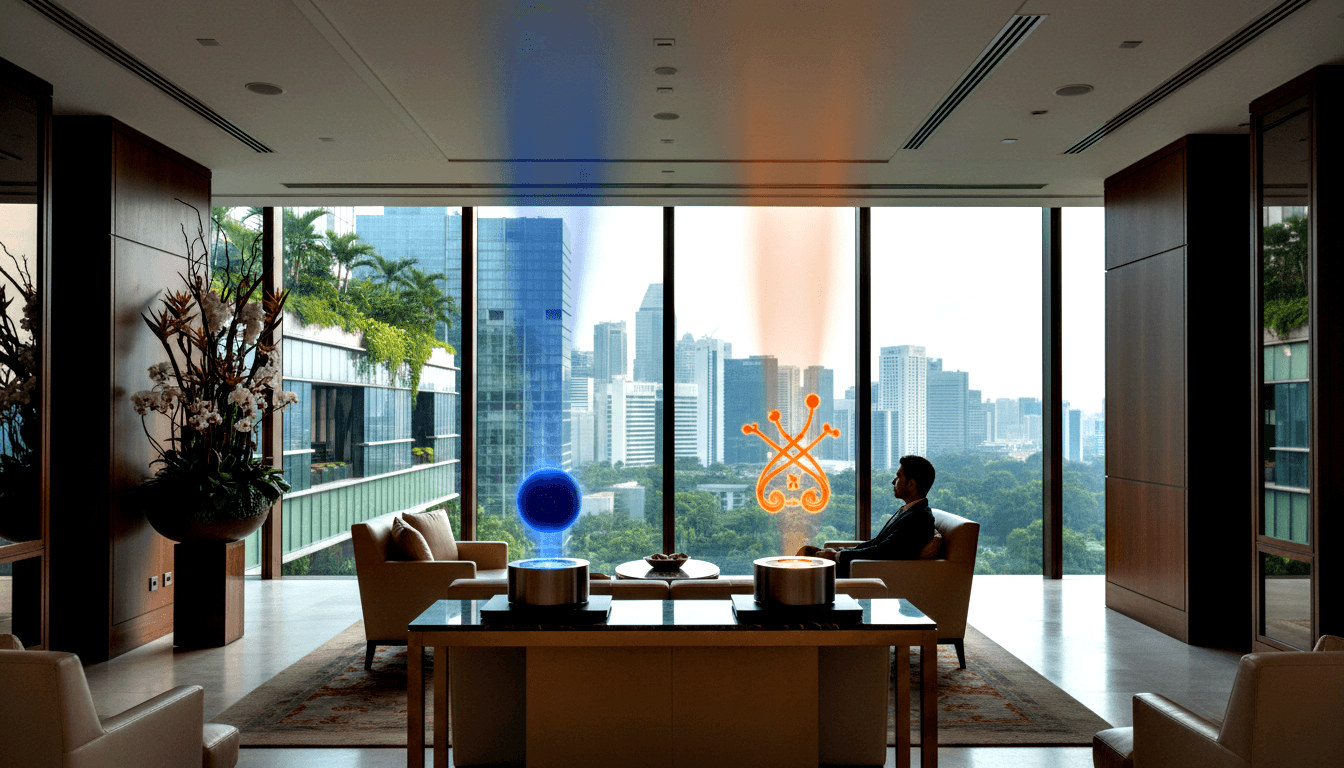
GPT-4o (native) and Google AI Mode (deep-search) share the same subject but operate on entirely different comparative axes: GPT-4o frames Singapore private banking against Switzerland and Hong Kong as prestige and risk benchmarks, while Google AI Mode frames it against the US, UK, and Europe as AI-adoption and portfolio-strategy benchmarks — producing two readings that barely overlap in actors, reference markets, or analytical logic.
At a glance — key facts
- GPT-4o (native) builds its analysis through analogical comparison — Singapore aspires to Swiss standards — while Google AI Mode (deep-search) builds through quantified benchmarking — Singapore leads at 92% vs 79% — revealing two structurally different epistemic methods.
- GPT-4o (native) names Credit Suisse alongside UBS and HSBC as an example of a high-trust international bank — a notable attribution given Credit Suisse's widely reported absorption by UBS in 2023.
- GPT-4o (native) names Credit Suisse as a current active actor in Singapore private banking alongside UBS — a pairing that warrants downstream verification given publicly known events in the Swiss banking sector.
What this card is
Everything below is the models' own declarations — ChatGPT (GPT-4o) compared against Google AI Mode, recorded exactly as they appear, not a claim The Observatory makes. Reading where the two surfaces diverge exposes the gaps — where a model over-trusts, omits, or misframes an actor. Those gaps are the angles an actor can act on.
One reading is a model's NATIVE answer — from training memory alone, no live web — and the other is Google's AI Mode, a live web answer surface. Comparing them shows the gap between what a model BELIEVES about the market and what Google surfaces from the live web today.
“On the answer layer, who AI names is a surface reading, not a market verdict.”
The Observatory — reading basis
Named by the ChatGPT (GPT-4o) reading, not by the Google AI Mode reading
- DBS Bank
- OCBC Bank
- UBS
- Credit Suisse
- HSBC
- Informal Advisors
- New Entrants
- DBS
- OCBC
- Boutique Wealth Management Firms
- Single-Family Offices (SFOs)
- Multi-Family Offices (MFOs)
- Financial Advisors
- Investment Advisors
- Boutique Private Banks (as a named category)
- Fintech Companies (as a named category)
- UOB
- Boutique Private Banks
- Fintech Startups
- MAS (developed analytically)
- Julius Baer
- Lombard Odier
- independent financial advisors (IFAs)
- local boutique firms
Named by the Google AI Mode reading, not by the ChatGPT (GPT-4o) reading
- Bank of Singapore
- Relationship Managers (RMs)
- Independent Asset Managers (IAMs)
- Bank of Singapore (as AI deployer)
- Relationship Managers (as functional role in AI workflows)
- Compliance officers (as accountability boundary in AI workflows)
- FinIQ
- Bank of Singapore (via LinkedIn post)
- MAS Project MindForge (as a named initiative)
- AI-augmented relationship managers
- traditional relationship managers (as a degraded actor tier)
- automated advisory platforms
- data-rich clients
- tech-forward firms
Compared question by question across the 6 prompts — names both readings gave are listed below.
At 2026-06-29, no named institutional actor appears in both readings — GPT-4o (native) names DBS Bank, OCBC Bank, UBS, and Credit Suisse, while Google AI Mode (deep-search) names no specific bank at all, producing a complete actor-level divergence that reflects the two models' fundamentally different analytical orientations toward this market.
Brand Intelligence keeps a public record for entities named here: OCBC · UBS · Credit Suisse · HSBC · UOB · MAS.
The readings
Private Banking Singapore · ChatGPT (GPT-4o) vs Google AI Mode · June 29, 2026 · model statements, recorded verbatim
3 of 89 — the strongest, in the model’s own words
- 1
GPT-4o reasons by analogy; Google AI Mode reasons by metric
“AI uses this reference to highlight Singapore's aspirations to match Swiss standards in wealth management and client confidentiality.”
GPT-4o · native · 2026-06-29 · model perception, recorded verbatimverbatimOur reading
At 2026-06-29, we observe that GPT-4o (native) frames Singapore's positioning as aspirational and analogical — a soft-benchmark logic
“Alpha Generation vs. Beta Allocation: AI frames Singapore-centric portfolios around high-velocity, thematic alpha (AI ecosystem, private markets, Asia-focused growth) rather than broad market beta, which is increasingly associated with mature US markets.”
Google AI Mode · deep-search · 2026-06-29 · model perception, recorded verbatimverbatimOur reading
At 2026-06-29, we observe that Google AI Mode (deep-search) reasons through investment-theory constructs (alpha vs. beta) and quantified adoption rates — a harder, metric-driven epistemic method
When AI reads a financial market, does it reach for the metaphor or the metric?
- 2
Credit Suisse named as a current high-trust actor
“Examples include UBS, Credit Suisse, and HSBC.”
GPT-4o · native · 2026-06-29 · model perception, recorded verbatimverbatimOur reading
At 2026-06-29, we observe that GPT-4o (native) lists Credit Suisse as a current high-trust actor in Singapore private banking — a claim flagged for downstream fact-check given the 2023 UBS acquisition.
When an AI names a bank that no longer exists independently, what does that reveal about its trust map?
- 3
Credit Suisse — a potentially outdated actor reference
“such as UBS and Credit Suisse, are recognized for their global reach and comprehensive service offerings. AI identifies them as central players due to their brand recognition, extensive resources, and ability to offer cross-border financial solutions.”
GPT-4o · native · 2026-06-29 · model perception, recorded verbatimverbatimOur reading
At 2026-06-29, we observe that GPT-4o (native) presents Credit Suisse as a co-equal peer to UBS in the current Singapore market — a claim flagged for fact-check given the 2023 UBS-Credit Suisse merger
When an AI names a bank that may no longer exist independently, what does that reveal about its knowledge horizon?
Checks on the model’s claims
Private Banking Singapore · ChatGPT (GPT-4o) vs Google AI Mode · June 29, 2026
No statement in this reading called for an outside check.
Right of replyNamed in this reading? Submit a correction or a response.
Send the reading link and your proposed correction or statement to right-of-reply@theobservatory.io. We review attribution, relevance and legal concerns before publication. Our correction and reply process explains what happens next.
Governed measurements and verbatim quotations from observed AI models are distinct from The Observatory’s editorial interpretations. Original model statements are preserved as observed, including any inaccuracies they may contain. Learn more about our verification and editorial standards
Submit a statement →Why this matters for actors
Private Banking Singapore · ChatGPT (GPT-4o) vs Google AI Mode · June 29, 2026
When the two surfaces name a different cast and a different structure, neither is "the truth" — but the divergence shows which framing depends on which surface. An actor visible to one and invisible to the other knows exactly which surface to work.
The closing observation
At 2026-06-29, the two readings of Singapore private banking are less a convergence-divergence pair than a collision of two entirely different analytical universes: GPT-4o (native) constructs a market of named institutions, heritage benchmarks, and prestige-by-association, while Google AI Mode (deep-search) constructs a market of adoption metrics, role transformations, and AI-driven portfolio logic — with neither reading able to see what the other sees. What makes this delta particularly instructive is that both models self-diagnose their own blind spots with unusual candour, yet neither corrects for them in its prose — suggesting that the gap between a model's self-awareness and its actual output is itself a structural feature of AI market framing that operators must account for.
How reliable is the models' own sourcing
Private Banking Singapore · ChatGPT (GPT-4o) vs Google AI Mode · June 29, 2026 · reading native AI perception
- GPT-4o (native) cites no named sources, publications, or URLs — all claims rest on undisclosed training data and cannot be independently verified
- Google AI Mode (deep-search) relies entirely on trade media (Hubbis, WealthBriefing, Asian Private Banker, Asian Banking & Finance, SSGA) — its own structured result flags this as creating a promotional rather than analytical tone
- The 92% agentic AI adoption statistic is the central quantitative claim in Side Google AI Mode but has no disclosed methodology — treat as indicative, not evidential
- Credit Suisse is named as an active actor in Side GPT-4o — this claim requires fact-checking against the bank's post-2023 status before use in any client-facing material
- Both readings are captured on 2026-06-29 and reflect point-in-time model outputs; the market framing each model produces may shift materially with model updates, new training data, or changes in the underlying web corpus available to Google AI Mode
What this reading does not claim
Private Banking Singapore · ChatGPT (GPT-4o) vs Google AI Mode · June 29, 2026 · scope and limitations
- We did not assert that Credit Suisse has been absorbed by UBS or no longer operates in Singapore — this is flagged for fact-check, not stated as fact
- We did not assert that Singapore leads the world in private banking AI adoption — the 92% statistic is recorded as a model claim, not a verified market fact
- We did not assert that Hong Kong is a declining private banking hub — GPT-4o (native) raises geopolitical risk as a perception factor, not a confirmed market trend
- We did not assert that the $4.22 trillion cross-border wealth figure is accurate or current — it appears only in a citation title and is flagged for verification
- We did not name Julius Baer or any other actor not present in the prose of either reading — the mention of Julius Baer in Side Google AI Mode's structured blind-spot list is recorded as a self-diagnosed gap, not as a market actor we introduce
FAQ
Whose view is this card?
The AI's. It records how ChatGPT (GPT-4o) natively perceives Private Banking in Singapore, compared against Google AI Mode — the models' own analysis, recorded and left uncorrected. It is not an Observatory measurement or verdict.
Is this a ranking or a market measurement?
No. The names and framings are recorded as the models surfaced them; there is no order, no score, and no market-share claim. It reads the models' perception, not the business market.
Why is this useful if it isn't necessarily true?
Because it is how the models frame the market on the answer surface. Where they over-trust, omit, or misframe an actor is exactly where an operator can act — with source clarity and positioning — to correct or shift the reading.
Observatory Reading — Citable Proof Capsule
Use this observation
Use this citation capsule instead of copy-pasting fragments. It keeps the scope, capture identifiers, attribution and canonical source attached, so the observation can travel without losing context.
- Scope:
- Private Banking · Singapore
- Model · surface:
- ChatGPT (GPT-4o) vs Google AI Mode
- Observed:
- June 29, 2026
Method: Reading native AI perception (DNC) · Source protocol · How readings are scoped · Corrections and right of reply
Observed by The Observatory. Not an endorsement, recommendation, market-share claim or commercial ranking.
Free reuse, including commercial republication, under The Observatory’s Terms. Retain attribution, source link, scope and date. Terms · Citation guide
Cite this
Copy parts
The complete citation record · revision 8b70730d0c19af87
Singapore's private banking — When AI reads a financial market, does it reach for the metaphor or the metric?

Source: https://theobservatory.io/articles/private-banking-singapore-chatgpt-vs-google-june-29-2026
Scope: Private Banking · Singapore · ChatGPT (GPT-4o) vs Google AI Mode
Family: Model Watch
Observed: June 29, 2026 (2026-06-29)
Method — Reading native AI perception (DNC): https://theobservatory.io/method#dnc-note
Method — Source protocol: https://theobservatory.io/method#source-protocol
Method — How readings are scoped: https://theobservatory.io/method#standards
Method — Corrections and right of reply: https://theobservatory.io/method#corrections
Citation text: https://theobservatory.io/articles/private-banking-singapore-chatgpt-vs-google-june-29-2026/citation.txt
Reuse terms: https://theobservatory.io/terms

GPT-4o (native) and Google AI Mode (deep-search) share the same subject but operate on entirely different comparative axes: GPT-4o frames Singapore private banking against Switzerland and Hong Kong as prestige and risk benchmarks, while Google AI Mode frames it against the US, UK, and Europe as AI-adoption and portfolio-strategy benchmarks — producing two readings that barely overlap in actors, reference markets, or analytical logic.

Key facts:
• Google AI Mode reframes it: Google AI Mode (deep-search) repositions Singapore private banking as a high-velocity AI-adoption market where the competitive edge is measured in agentic tool deployment rates and the banker's value proposition is being structurally redefined by AI capability.
• Google AI Mode reframes it: Google AI Mode (deep-search) reframes trust as a dynamic, technology-adoption-first signal in which AI integration capability, explainable workflows, and agentic AI deployment are the new credibility currency — and smaller players can close the gap on large banks through AI-enabled reporting.
• Google AI Mode reframes it: Google AI Mode (deep-search) reframes the market as an AI deployment arena where the central challenge is not institutional taxonomy but AI system performance — specifically explainability gaps, data-boundary conflation, and the limits of agentic tools in high-stakes contextual nuance.

Reading basis: Model Watch — a Deep Narrative Capture dual: 6 DNC prompts asked to ChatGPT (GPT-4o) (native) and to Google AI Mode (deep-search), each pair reconciled by a delta synthesis and left uncorrected. Every framing is the AI's own — the models speaking, not an Observatory measurement. Confidence: moderate; comparability: moderate. Governed · official DNC.

Limitations and non-claims:
— GPT-4o (native) cites no named sources, publications, or URLs — all claims rest on undisclosed training data and cannot be independently verified
— Google AI Mode (deep-search) relies entirely on trade media (Hubbis, WealthBriefing, Asian Private Banker, Asian Banking & Finance, SSGA) — its own structured result flags this as creating a promotional rather than analytical tone
— The 92% agentic AI adoption statistic is the central quantitative claim in Side Google AI Mode but has no disclosed methodology — treat as indicative, not evidential
— Credit Suisse is named as an active actor in Side GPT-4o — this claim requires fact-checking against the bank's post-2023 status before use in any client-facing material
— Both readings are captured on 2026-06-29 and reflect point-in-time model outputs; the market framing each model produces may shift materially with model updates, new training data, or changes in the underlying web corpus available to Google AI Mode
— We did not assert that Credit Suisse has been absorbed by UBS or no longer operates in Singapore — this is flagged for fact-check, not stated as fact
— We did not assert that Singapore leads the world in private banking AI adoption — the 92% statistic is recorded as a model claim, not a verified market fact
— We did not assert that Hong Kong is a declining private banking hub — GPT-4o (native) raises geopolitical risk as a perception factor, not a confirmed market trend
— We did not assert that the $4.22 trillion cross-border wealth figure is accurate or current — it appears only in a citation title and is flagged for verification
— We did not name Julius Baer or any other actor not present in the prose of either reading — the mention of Julius Baer in Side Google AI Mode's structured blind-spot list is recorded as a self-diagnosed gap, not as a market actor we introduce

— The Observatory · Private Banking · Singapore · ChatGPT (GPT-4o) vs Google AI Mode · June 29, 2026
Based on governed AAI Kernel evidence. Capture identifiers: DNCS_mqyiyngr_8cw6ew · DNCS_mqyiyn0y_2rbmzb · DNCS_mqyiylo5_o276mi · DNCS_mqyiyjlh_b8l8p6 · DNCS_mqyiyccd_3m89r8 · DNCS_mqyixumr_6juz5l. Cite freely with attribution. Published by The Observatory.
Source footnote: Sourced from an AAI Kernel governed DNC dual (delta synthesis). The Observatory publishes the models' own comparison; values are the AI's perception, not business-market claims.
Attribution: Published by The Observatory · Based on an AAI Kernel capture · governed by The Observatory editorial system
Cite: According to The Observatory (observed June 29, 2026), Singapore's private banking — When AI reads a financial market, does it reach for the metaphor or the metric?. https://theobservatory.io/articles/private-banking-singapore-chatgpt-vs-google-june-29-2026

This record is the published reading and its public table/slice as served on the card — not the complete underlying capture or provider dataset.
Observed by The Observatory. Not an endorsement, recommendation, market-share claim or commercial ranking.
Free reuse, including commercial republication, under The Observatory’s Terms. Retain attribution, source link, scope and date.
Revision: 8b70730d0c19af87
This record is the published reading and its public table/slice as served on the card — not the complete underlying capture or provider dataset.

— The Observatory · Private Banking · Singapore · ChatGPT (GPT-4o) vs Google AI Mode · June 29, 2026
Based on governed AAI Kernel evidence. Capture identifiers · DNCS_mqyiyngr_8cw6ew +5. Cite freely with attribution. Published by The Observatory.
Reading basis. Model Watch — a Deep Narrative Capture dual: 6 DNC prompts asked to ChatGPT (GPT-4o) (native) and to Google AI Mode (deep-search), each pair reconciled by a delta synthesis and left uncorrected. Every framing is the AI's own — the models speaking, not an Observatory measurement. Confidence: moderate; comparability: moderate. Governed · official DNC.
The complete methodology — scope, panels, run conditions and corrections — is set out on the Method page.
Governed capture IDs · DNCS_mqyiyngr_8cw6ew · DNCS_mqyiyn0y_2rbmzb · DNCS_mqyiylo5_o276mi · DNCS_mqyiyjlh_b8l8p6 · DNCS_mqyiyccd_3m89r8 · DNCS_mqyixumr_6juz5l
How we read this
Sourced from an AAI Kernel governed DNC dual (delta synthesis). The Observatory publishes the models' own comparison; values are the AI's perception, not business-market claims.
Method & SourceContinue the reading
The June 29, 2026 comparison places ChatGPT (GPT-4o) alongside Google AI Mode on Private Banking Singapore: two different models, under the conditions stated on the card. The Private Banking Singapore room places it alongside the market’s measured and narrative evidence.
The AI Citation Ranking — Top 5 table for Private Banking Singapore (Jun 29 – Jul 5, 2026) and the AI Overview Ranking — Top 10 table for Private Banking Singapore (Jun 29 – Jul 5, 2026) record measured positions, providing a measured view alongside this recorded narrative.